

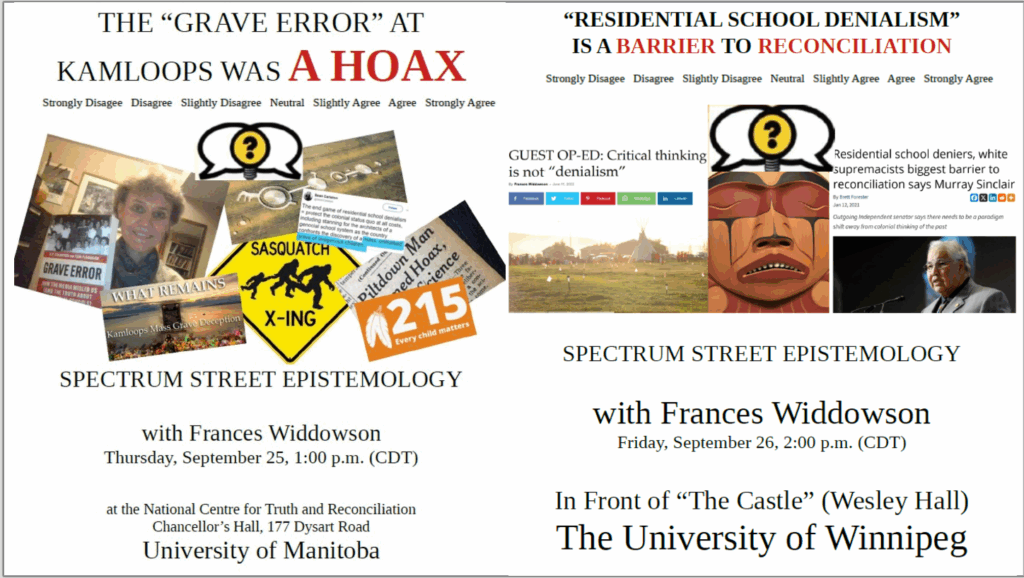
On September 25 (1:00 p.m. CT) at the University of Manitoba, and September 26 (2:00 p.m. CT) at The University of Winnipeg, Frances Widdowson is coming in to do Spectrum Street Epistemology.
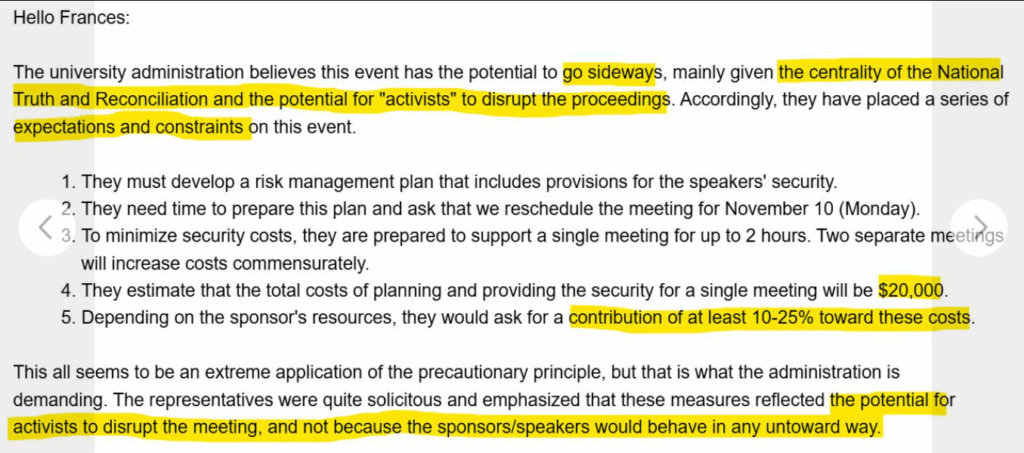
The reason why Widdowson decided to go in with the Spectrum Street Epistemology is because the University of Manitoba decided that it would charge her organization, the Society for Academic Freedom and Scholarship, between $2,000-5,000 in “security” fees for a crisis that this university has created. This is because it has activist elements that are controlling everything at this institution. These activists, like Sean Carleton and Niigaan Sinclair, have been rewarded by this institution.
The announcement about Widdowson coming to the University of Manitoba resulted in Niigaan Sinclair writing a column in the Winnipeg Free Press.
As Widdowson is sure that the Winnipeg Free Press will not give her a right of reply, due to its capture by “indigenization” and “decolonization” forces, she posted her reply on social media.
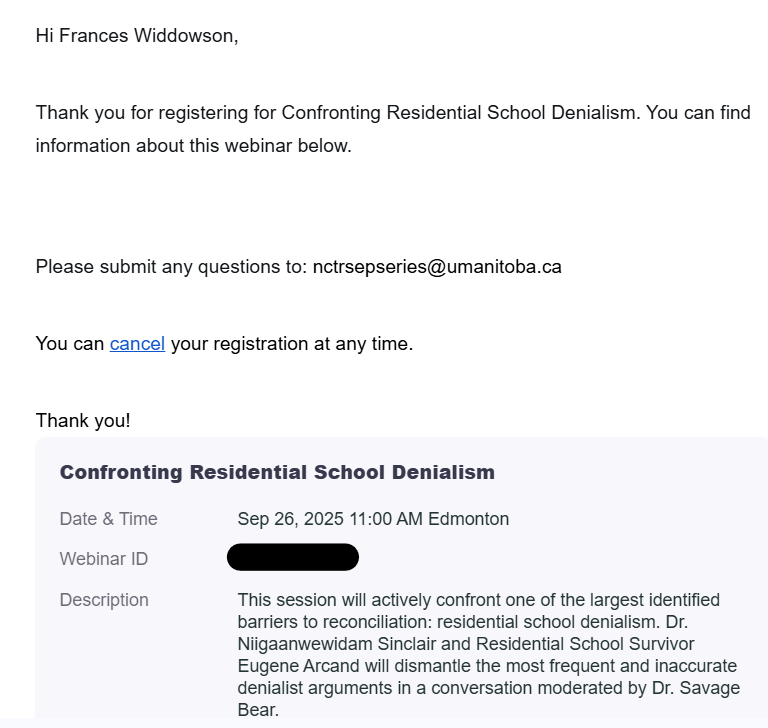
The reason for the claim chosen for The University of Winnipeg is because Niigaan Sinclair is participating in a panel discussion at the National Centre for Truth and Reconciliation on Zoom two hours before, from 12-1:00 p.m. CT on September 26, saying that “one of the largest identified barriers to reconciliation” is “residential school denialism”.
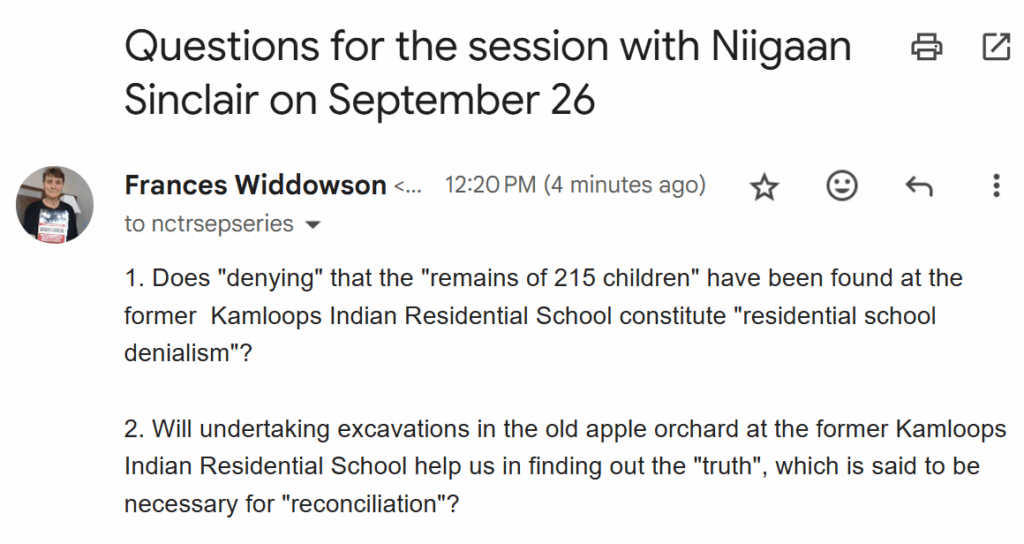
Widdowson will be watching the Zoom session, and will compile the various forms of evidence that Sinclair provides. She also has submitted two questions to the session.

It is puzzling that a survey technique that can provide only hypotheses for what exists beneath the ground surface, is being allowed to trigger unnecessary grief among Indigenous people. As an Earth scientist familiar with geophysical sounding techniques, I know that the use of ground-penetrating radar (GPR) to ‘confirm’ any subsurface feature is an extension of the technique beyond its capability. All geophysical sounding techniques require ground-truthing, an actual exposure of the detected feature to determine what the feature actually is. Without ground-truthing, the survey is essentially worthless. The features detected could be a variety of subsurface objects or conditions.
The Kamloops Indian Residential School GPR-detected ‘graveyard’ is perhaps the most blatant misuse of the GPR technique. What I find amazing is the reluctance of the Kamloops First Nation to test their GPR findings with a respectfully conducted archeological excavation. In all likelihood, no human remains will be found. Would this finding not be cause for emotional relief?
Dr. Larry Dyke
North Vancouver BC
As an indigenous elder and knowledge keeper I agree with Dr. Dykes observations and comments. I think the reason the 1st Nations community is reluctant to go further is not the sacredness they claim, they fear that if no bones are found it will further fuel the belief that residential schools were not as harsh as claimed, just look at the smiling faces of some so called survivors, in some cases they ran the schools and there were a lot of bullies, I know, I experienced it. The indigenous community will lose credibility and money. On the other side a victory for the naysayers will just further boost their already dislike of indigenous people and will be touting, ” I told you so , it’s all BS “. No one wins. A-ho!