This post is discussed in a video that I created on November 8, 2025.
One of the most significant confusions that is happening with the Kamloops case is the conflation that often occurrs with claims about clandestine burials, where it has been implied that 215 children were murdered, and the student deaths that occurred because of accidents and disease.
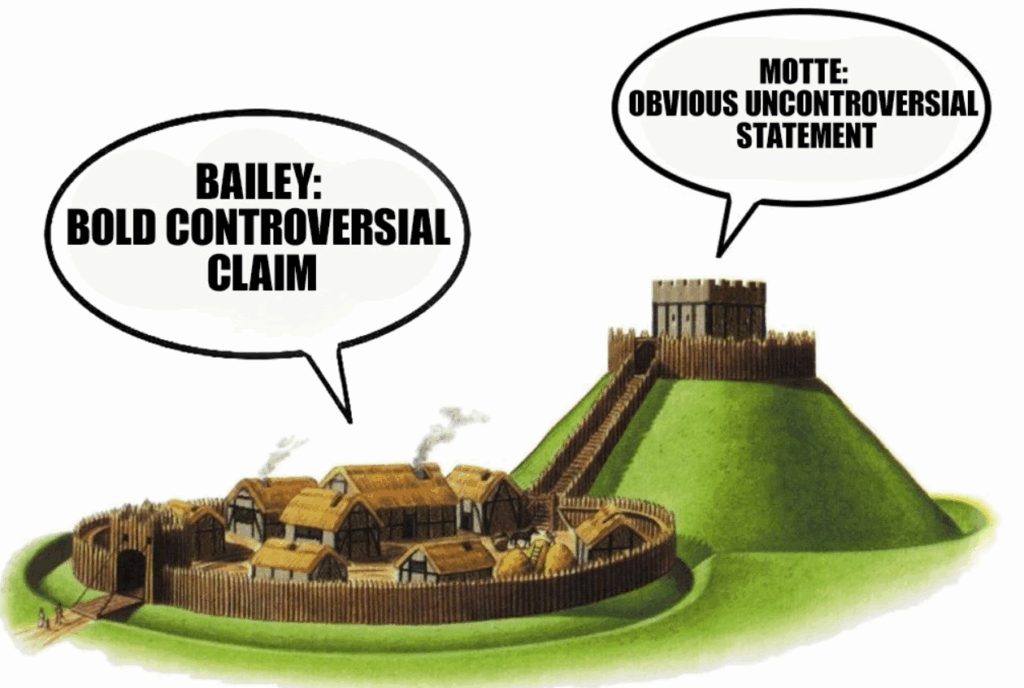
In military parlance, this is often referred to as the “motte and bailey”. The bailey is the “fertile valley” that is sought after – the “bold controversial claim”. When this claim is challenged, a switch occurs and an “obvious uncontroversial statement” is made in its place. The “motte”, which is a dark and dank castle that people retreat to so as to defend their position.
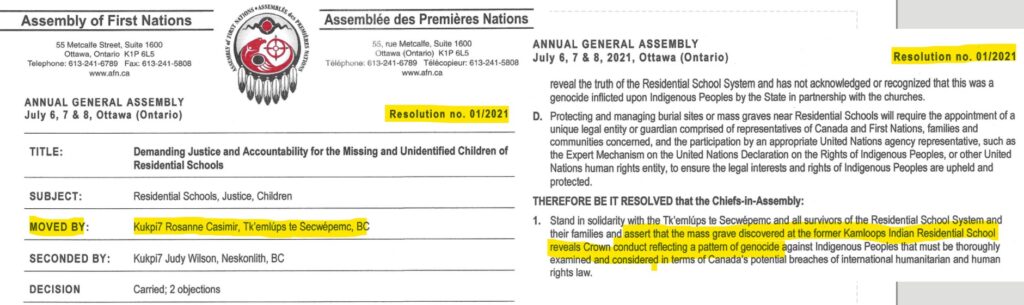
In the Kamloops case, Rosanne Casimir asserted in July 2021 at the Assembly of First Nations Annual General Assembly that “the mass grave discovered at the former Kamloops Indian Residential School reveals Crown conduct reflecting a pattern of genocide against Indigenous Peoples…”. This is the “bailey”.
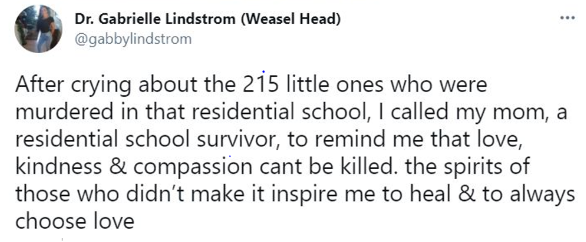
When it became apparent that there was no evidence for the claim of clandestine burials (i.e. “the 215 little ones who were murdered”, according to Gabrielle Lindstrom (Weasel Head)), as the only support was hits on the GPR and stories of the “Knowledge Keepers”, scholar-activists like Sean Carleton deployed the “motte” – that “church and state records have already confirmed 51 deaths at KIRS”.
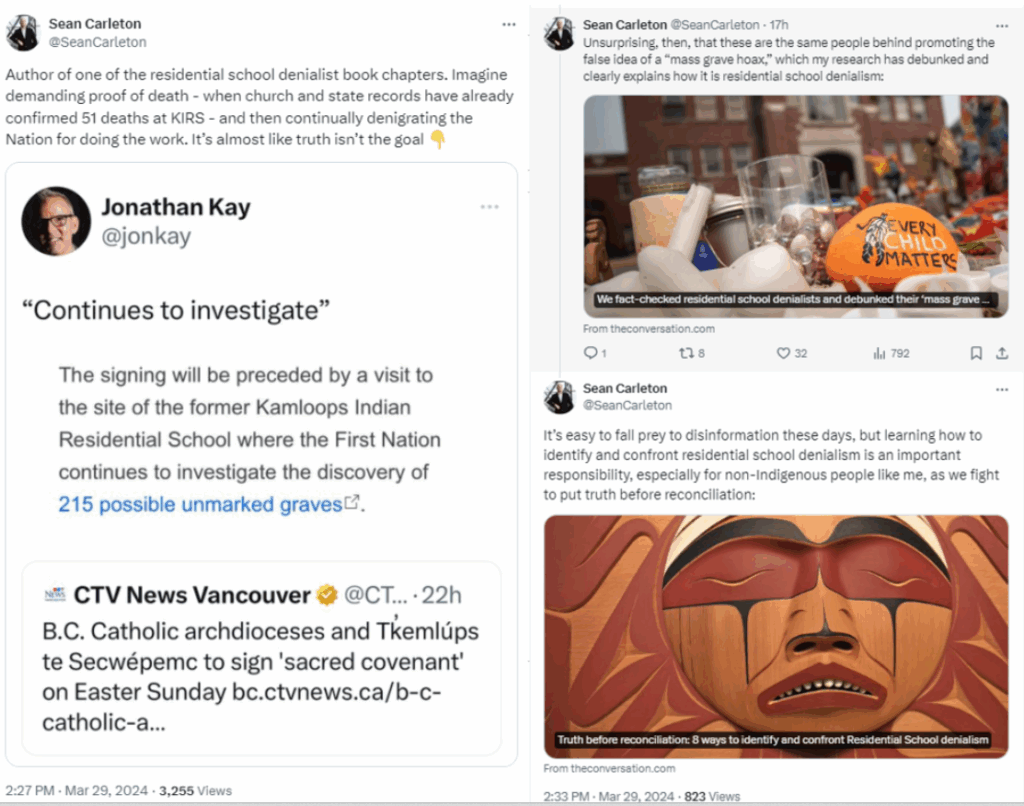
No one, however, has disputed that some students at KIRS died from accidents or disease, and that these students are buried in cemeteries where the grave markers have deteriorated. These graves are not what one would call “unmarked graves” as they are not clandestine burials.
One of the first efforts to document these deaths occurred on January 11, 2022, when Jacques Rouillard, a history professor from the University of Montreal, published an article that exposed the “grave error deception” at Kamloops. This article was based on the research undertaken by Nina Green.
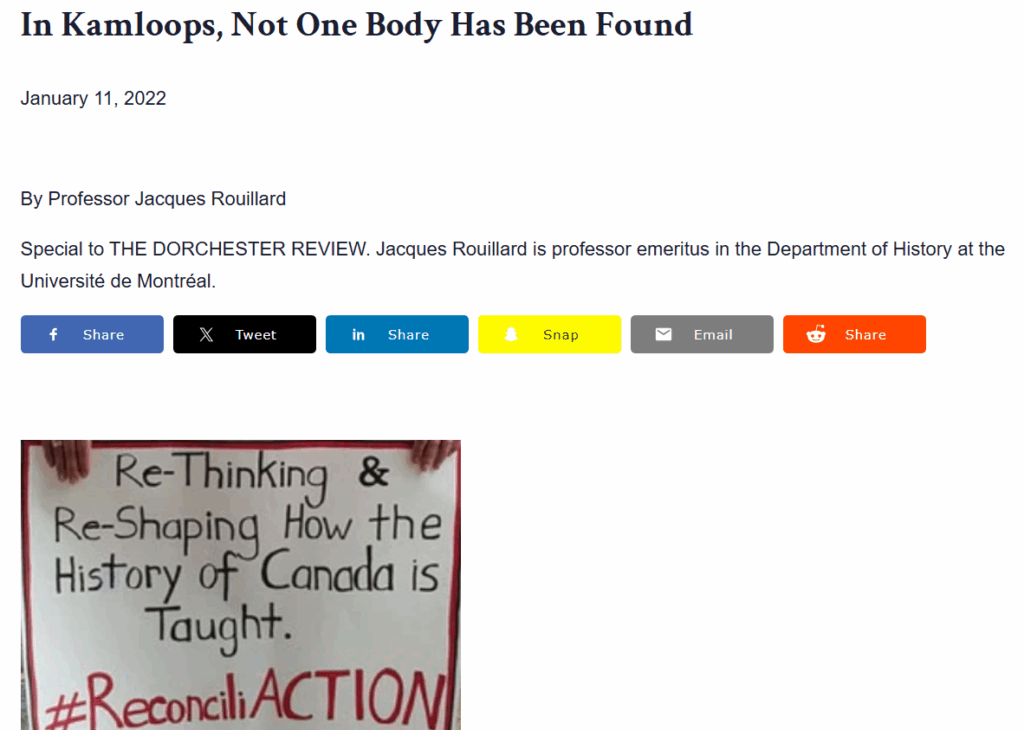
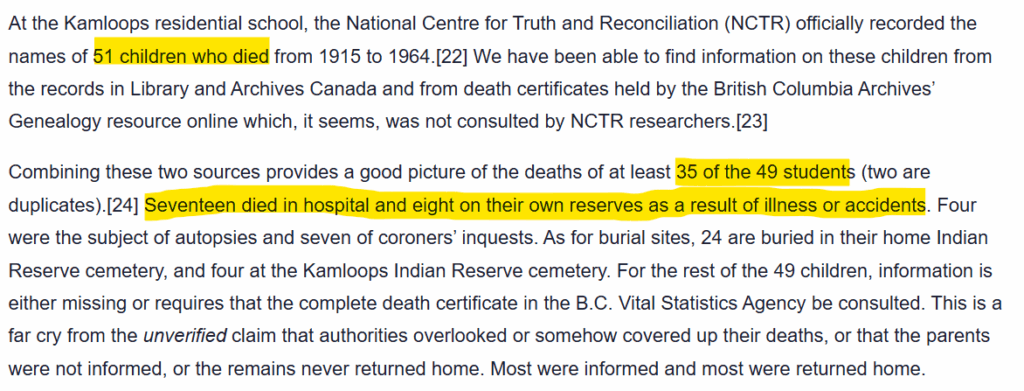
In this article, Rouillard pointed out that there were 49 deaths associated with the Kamloops Indian Residential School (two of the names were duplicates, which is why the number is not 51, as Sean Carleton claims). Examining the 35 death records that were obtained, however, found that 25 of the 49 did not die at the school.
In 2023, a spreadsheet compiled by Nina Green shows all 51 records from the National Centre for Truth and Reconciliation (the yellow highlighted areas are the duplicates). Of the 40 death records located, it appears that only four students died at the Kamloops Indian Residential School – 2. Adrian Reynold G. George (asphyxia), 34. Marguerite Fallardeau (pericarditis), 39. Pearl Joe (drowning) and 48. Theophile Dick Billy (tuberculosis meningitis). The blue highlighted areas are the four deaths that actually occurred at the school.
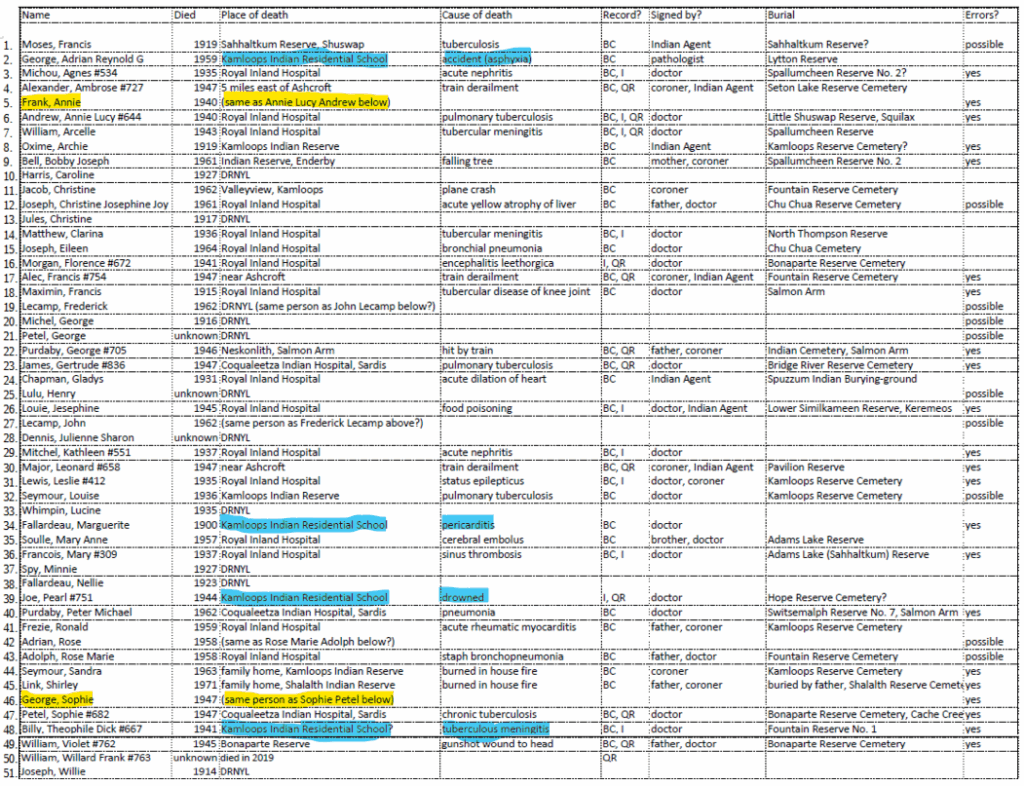
The death records are available here. Below is one of the death certificates, which is the case of the second student on the spreadsheet – Adrian Reynold G. George. The death certificate is signed by a pathologist, and notes that the student is buried in the Lytton Indian Cemetery. The death certificate notes that the student died of asphyxia and strangulation and that it was an accident. Thirty-one cemeteries are referred to on the spreadsheet above.
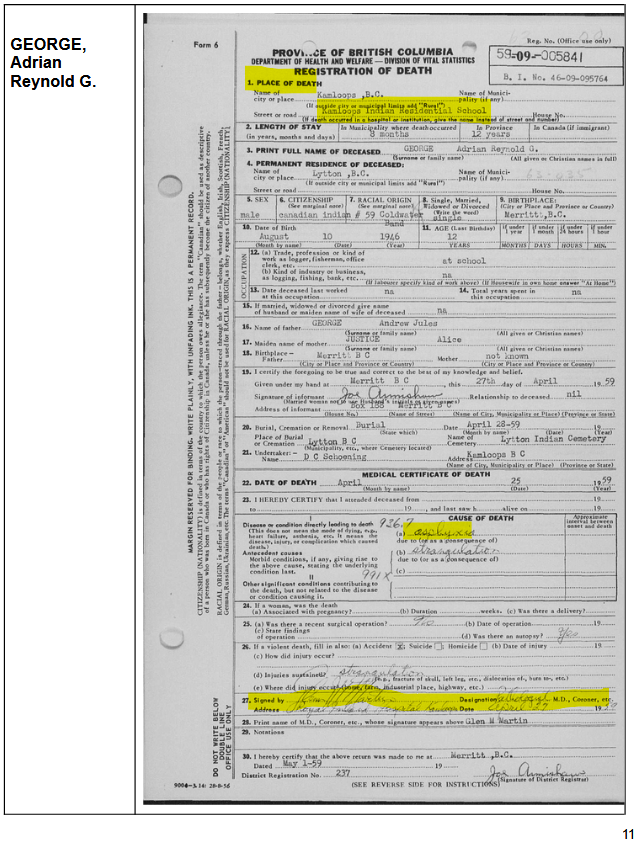
What is not provided on the death certificate is the detail that this student died from hanging himself accidentally when playing the game of “outlaw” (see page 148 of Celia Haig-Brown’s 1986 thesis “Invasion and Resistance” below). .
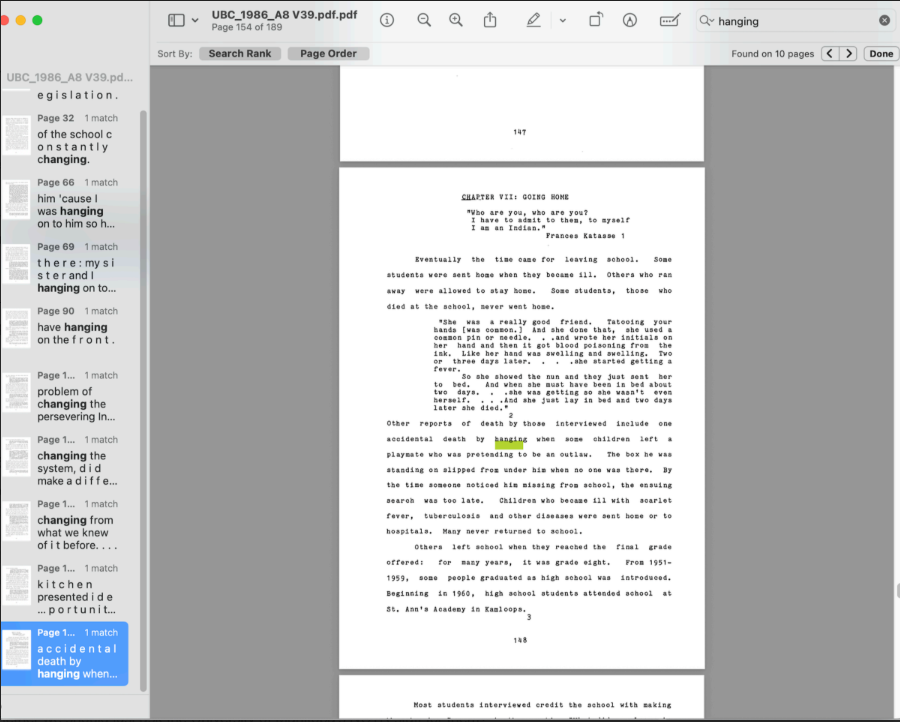
The accidental hanging of George is possibly the source of the claim made by Audrey Baptiste that she saw four boys hanging in a barn. This claim was reported uncritically by Gillian Findlay in The Fifth Estate’s investigative documentary in January 2022.
Recently, however, the National Centre for Truth and Reconciliation has updated its list to now total 82 names. Although a number of the death records have been obtained, they have not been compiled into the spreadsheet. The highlighted names are those where the death records are still outstanding. These death records can be obtained from BC=BC Death Record, I=Department of Indian Affairs inquiry into student death (1935-1945), or QR=Library and Archives Canada School Files Series quarterly return (these sources are noted in the spread sheet compiled by Nina Green above).
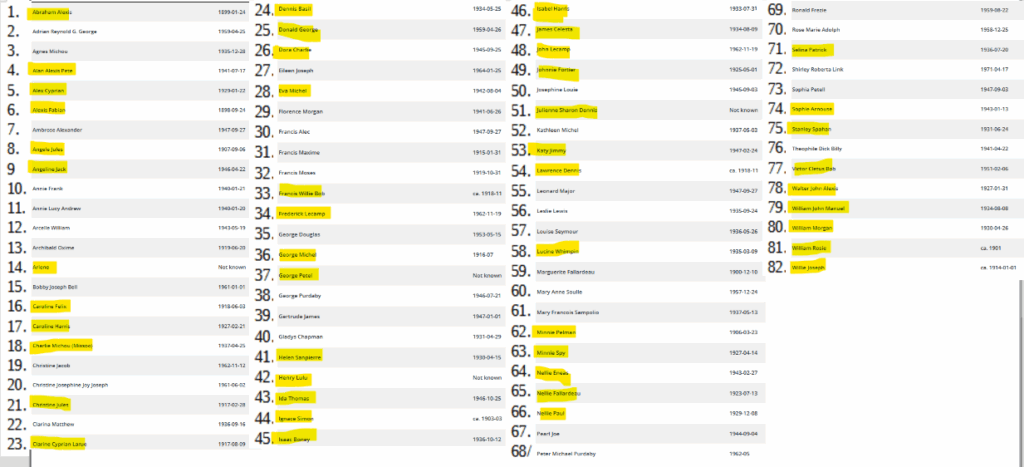
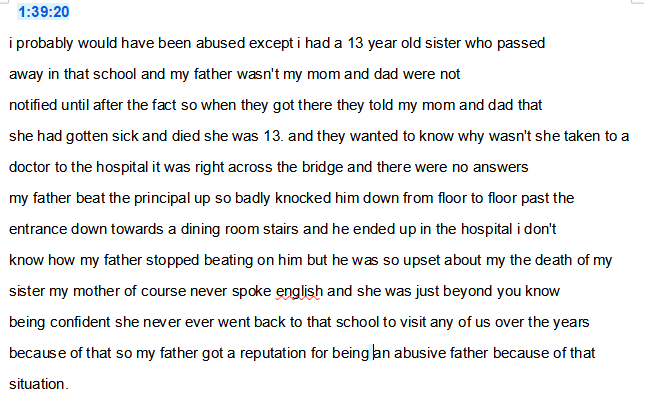
One of the most interesting names on the new list is Nellie Eneas (#64 on the NCTR’s list of 82; Eneas is an alternate spelling for Ignace). Nellie Eneas was the sister of Mona Jules. Jules was one of the “Knowledge Keepers” who presented at the event held on July 15, 2021 to reveal the GPR operator Sarah Beaulieu’s findings that only 200 “targets of interest” had been “confirmed”. Jules’ presentation begins at 1:28:18.
In her presentation, Mona Jules states that Nellie “passed away in that school and…my mom and dad were not notified until after [she died]”. Mona Jules maintained that Nellie was “not taken to a doctor to the hospital”, and when her father found out he “beat the principal up so badly, knocked him down from floor to floor” and the principal “ended up in the hospital”.
Mona Jules’ account of the Kamloops Indian Residential School is also available in the book Behind Closed Doors (published in 2000).
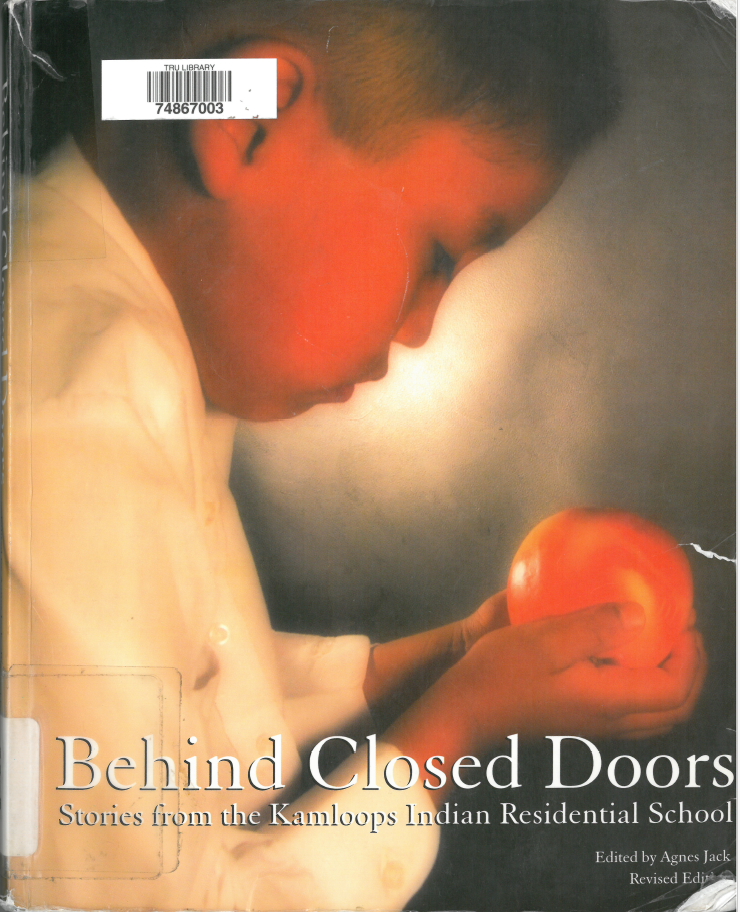
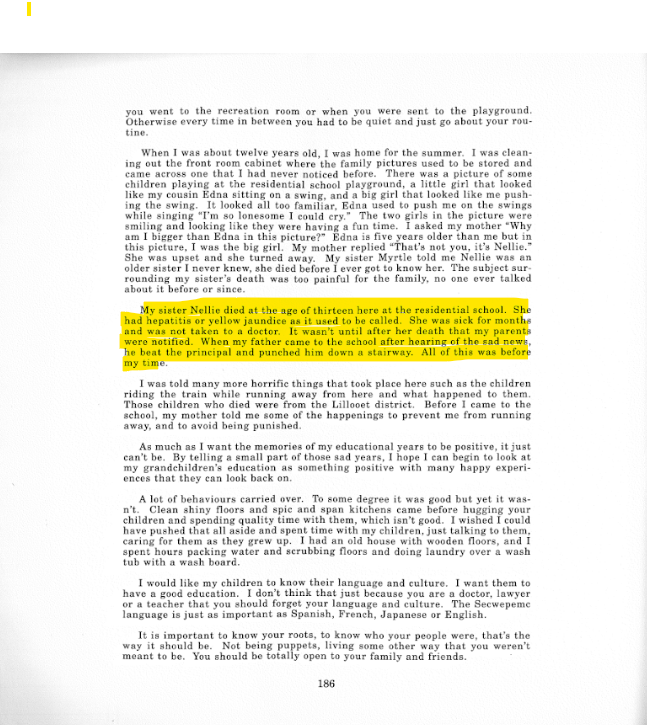
In this book (p. 186), Jules asserts that Nellie – who she did not know – had died from “hepatitis or yellow jaundice”. She claims that her father, a prominent member of the community and a chief of the band, had not been told about her illness and death, and so he beat up the principal.
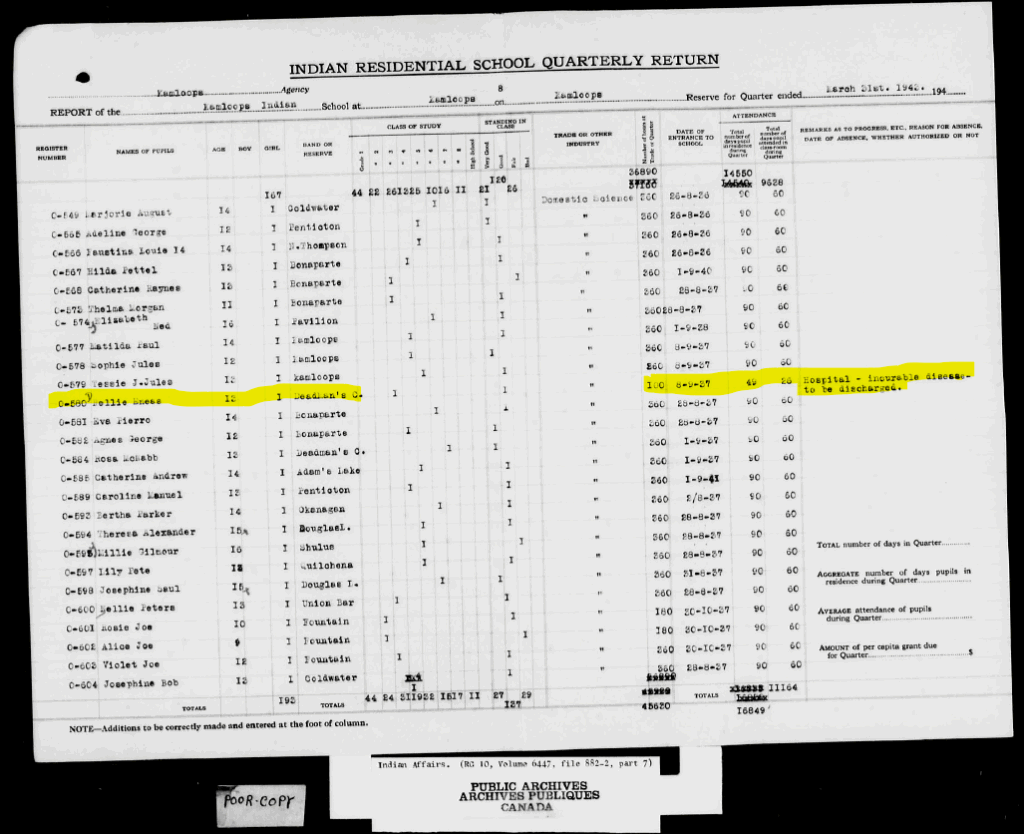
According to the March 31, 1943 Indian Residential School Quarterly Return, Nellie was in hospital, “to be discharged”, due to the fact that she had an incurable disease.
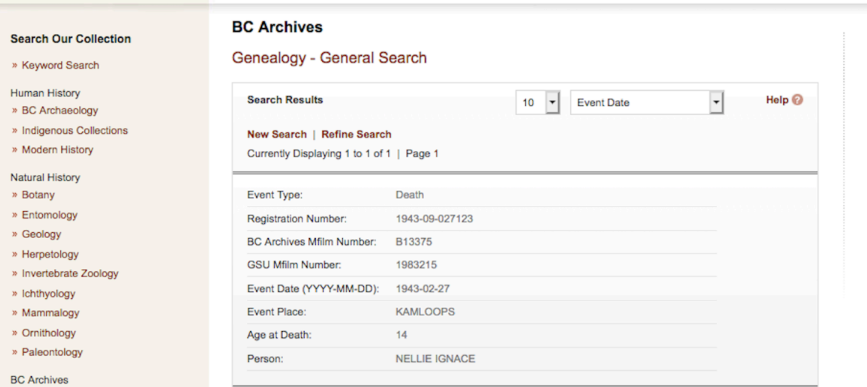
According to a BC Archives record, Nellie died on February 27, 1943.
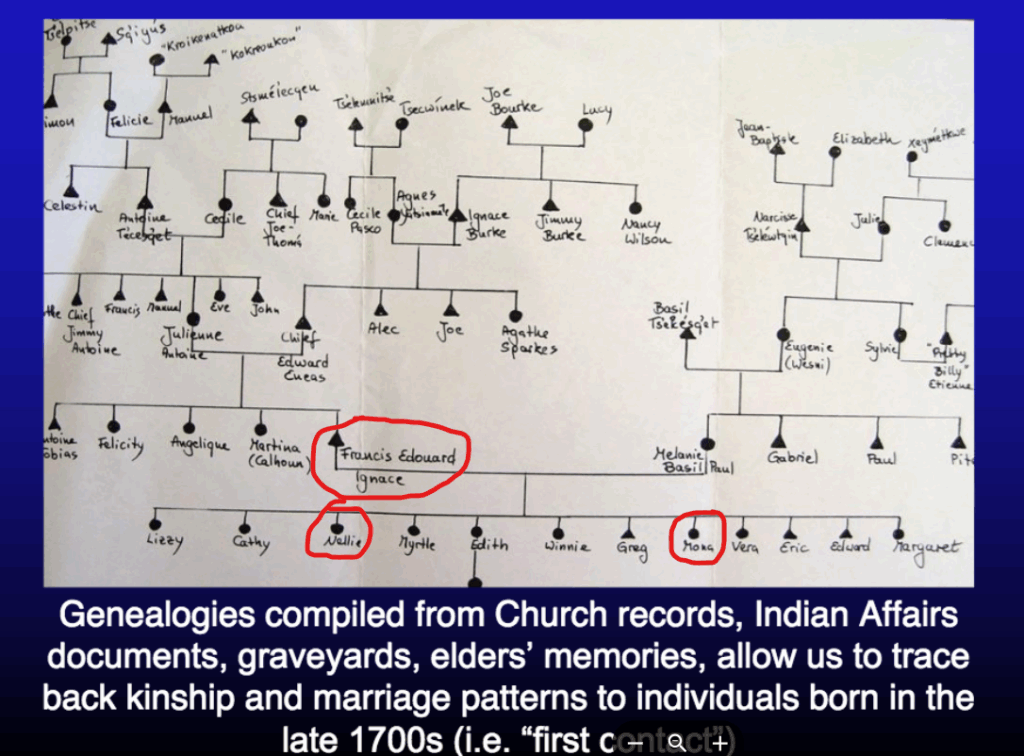
Mona Jules’ father, according to a genealogy chart by Marianne Ignace, was Francis Edouard Ignace.
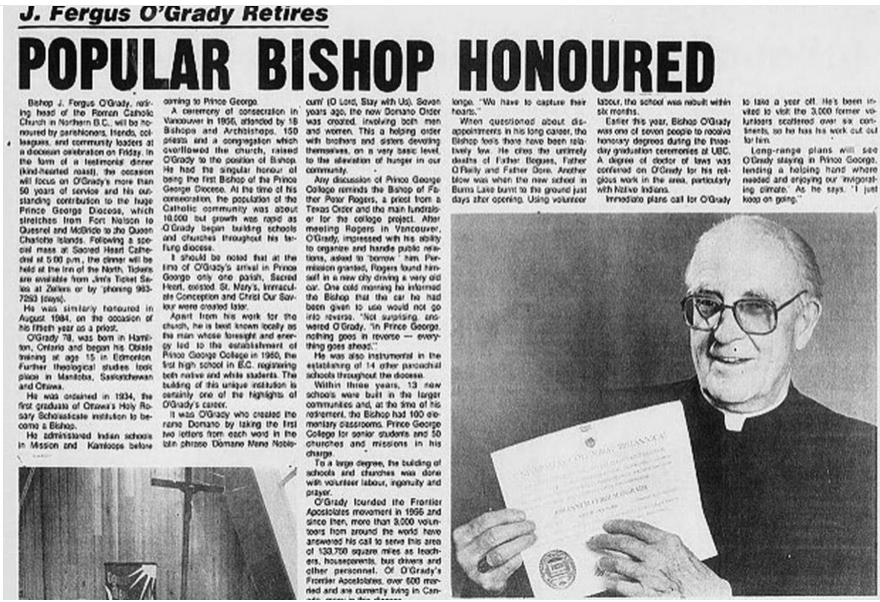
In 1943, the principal of the Kamloops Indian Residential School was James Fergus O’Grady. In examining Mona Jules’ claim, one would need to examine the records as to whether any report was made to police or if any of the records mention a father beating up the principal. Without any records to corroborate this incident, we must remain skeptical of it as it seems to be improbable.
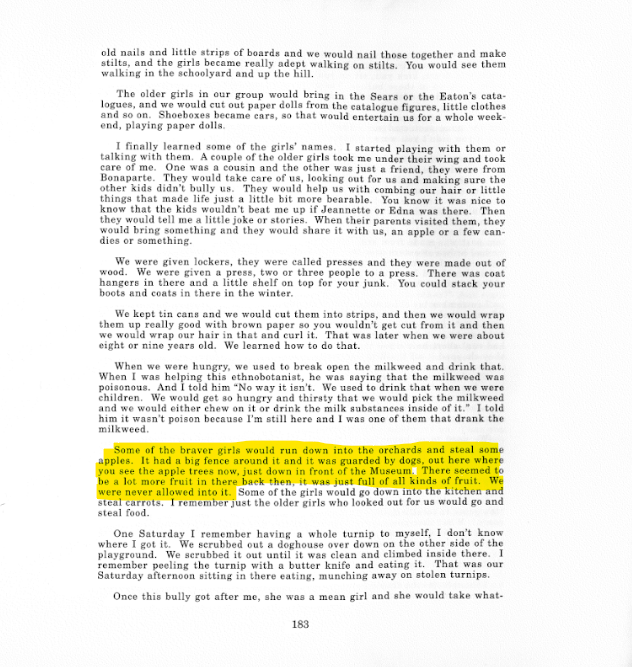
In Behind Closed Doors (p. 183), Mona Jules also referred to the apple orchard. She just mentions some girls stealing apples and said that “it had a big fence around it and it was guarded by dogs”. She does not talk about anything concerning burials. As Mona Jules was a “Knowledge Keeper”, one would have expected her to be aware of any supposed burials. And if she was aware of these burials, why wouldn’t she have mentioned it in this interview in 2000.
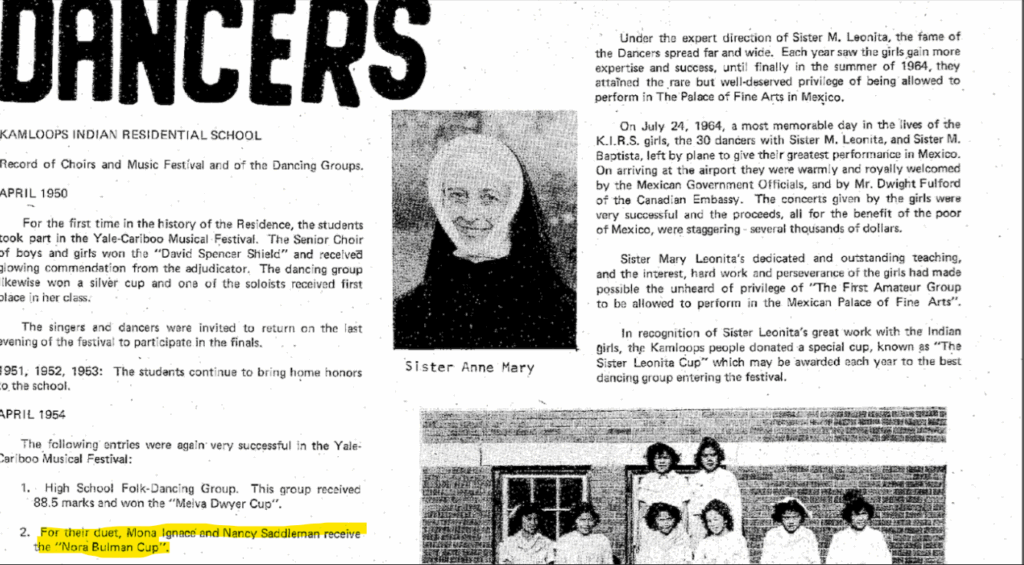
In the 1977 souvenir edition publication from the KIRS reunion, Mona Jules (nee Ignace) is mentioned as having been one of the dancers from KIRS who entered the Yale-Cariboo Music Festival in 1954.
The list of who attended the reunion is available. According to the guest book that signed by many people, “over 280 former students and staff attended the reunion”. Two attendees are worth noting – Bishop Fergus O’Grady, who was supposedly beaten up by Mona Jules’ father. The other was Chief Harvey McLeod of the Upper Nicola Band.
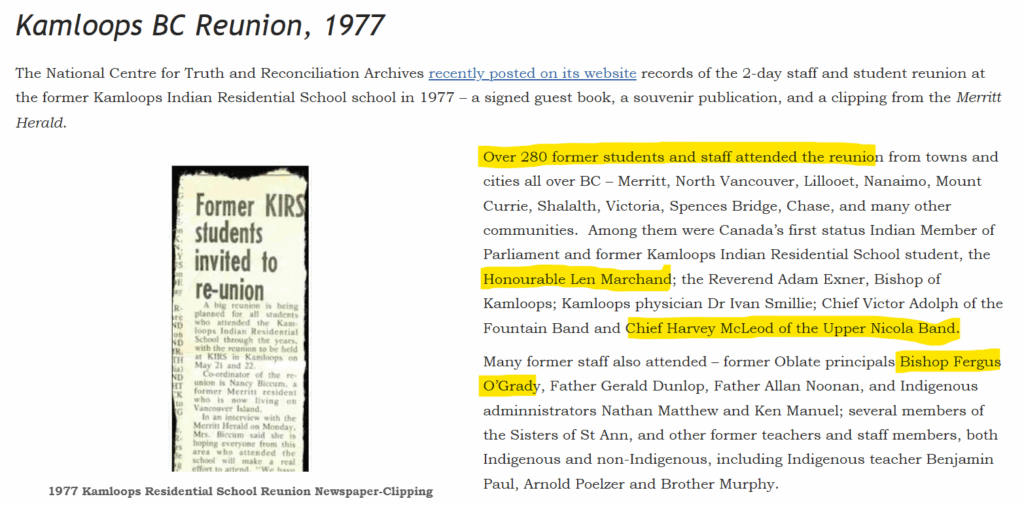
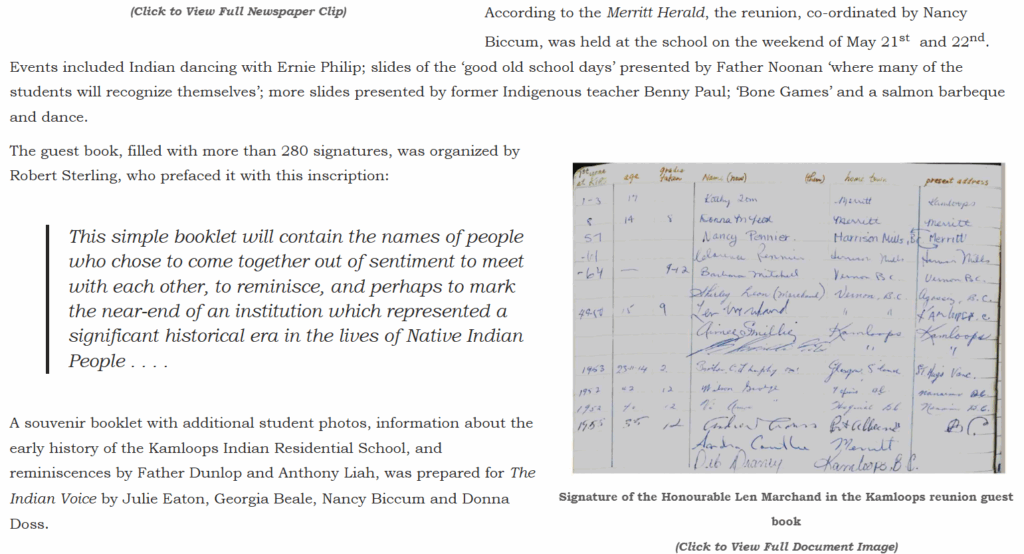
Chief Harvey McLeod is of note because he was interviewed by Gillian Findlay in The Fifth Estate investigative documentary. McLeod stated that a gentlemen that he had spoken with had told him that “he was given a box to put in [the furnace room] and a baby fell out”. Why would Chief McLeod attend a reunion with staff members who he believed were throwing babies in the furnace? And even if McLeod did not find out about this highly improbable incident until after the reunion, his discussion with Gillian Findlay indicates that he always thought that the Kamloops Indian Residential School was a “horrible place”.